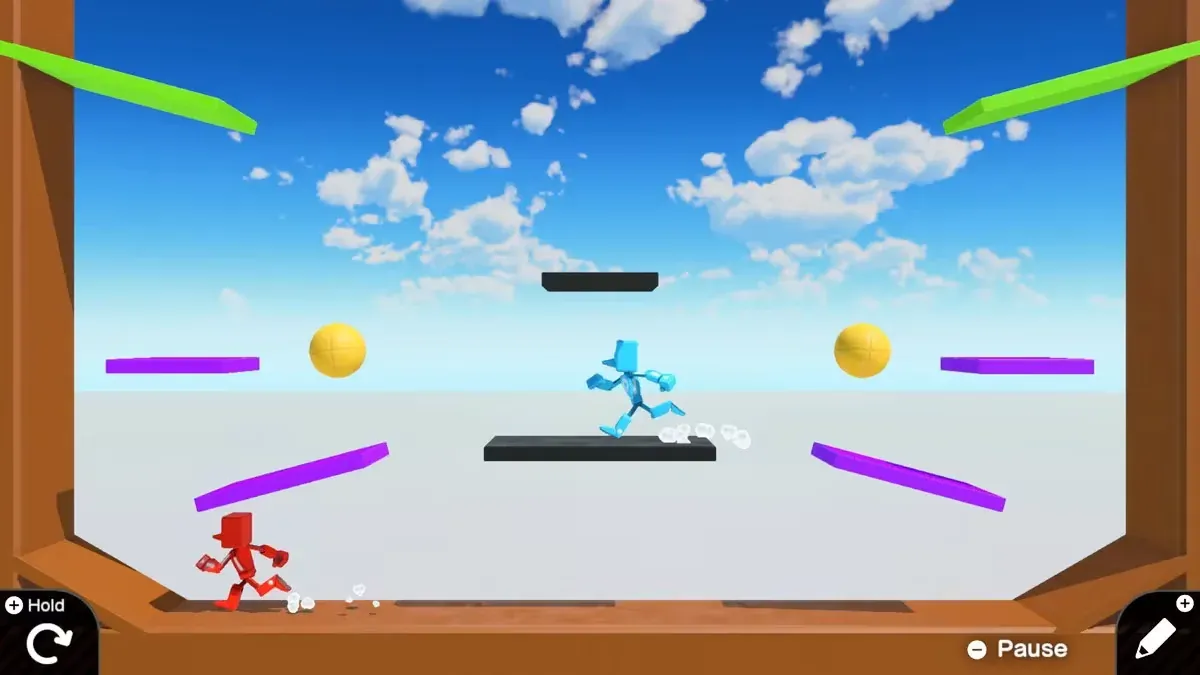
Players can browse community creations, build their own scenes or games with in-engine tools, and publish them back into the Dreamiverse.
Why it may be useful
You get real, professional-grade creation tools for sculpting, animating and wiring up interactive scenes, and the habit of building, testing and revising something small at a time. What does not carry over is the tool itself: nothing you make here works anywhere else.
Written 2026-09-15 · editorial assessment, not a measured effect · how we rate →
What the game is
Dreams is a creation tool and a library of other people's games, made by Media Molecule and published by Sony for PlayStation 4 in 2020. It runs on PlayStation 5 as well. Half of it is a browser: you scroll a feed of things other players have made and play them, from short games to music videos to whole adventures. The other half is the editor that made all of them.
That editor is unusual because it is not a code window. You sculpt three-dimensional shapes with a cursor called an imp, paint them, animate them, add sound, and wire up behavior with visual logic chips instead of typed instructions. Media Molecule built its own story, Art's Dream, inside the same tools as a demonstration of what they can do.
Live support from Media Molecule ended in September 2023. The game is still sold and still works: you can play, create and publish. But the trial version was withdrawn and some web-linked features on the companion site were switched off, so what is there now is a large archive rather than a growing service.
What you actually do
If you are creating, you start with empty space, pull a shape out of it, stretch it, clone it, and carry on until the thing looks right. Then you give it behavior: a logic chip that says when this is touched, play that sound and move this way. The controller works as a pointer, using either motion or the sticks, so sculpting feels closer to modeling clay than to using a mouse. If you are playing, you browse the feed, pick something, try it and rate it. Most people do both, and getting better means learning to test a small piece, watch it fail, and change one thing instead of rebuilding.
What it exercises
Breaks an idea into parts small enough to build and test one at a time
Wires cause and effect using visual logic rather than typed code
Sculpts and edits a three-dimensional shape toward an intended result
Publishes work for strangers and reads their reaction to it
Takes apart someone else's creation to see how it was made
Why we rate it Moderate Worksheet score 67 / 100
FitHow much real knowledge or skill does the play itself make you use?65weight 45%
Fit sits at 65. Building, testing and revising inside Dreams is real design practice, and the tools that made the developers' own game are the same ones handed to the player. It stays in the middle of the scale because the editor is a closed system of Media Molecule's own invention rather than a real production pipeline, so what you learn is design reasoning reduced to a few proprietary levers.
TransferWill what you practise here work outside the game?60weight 30%
Transfer is 60. The habit of breaking a project into testable pieces and iterating on failure is a real, general skill that travels to any kind of making. But nothing technical carries with it: the visual logic is not a language used anywhere else, and no project made here can be exported, so this is a reasoning habit rather than a portable tool.
PracticeDoes the game make you use that skill again and again, as it gets harder?80weight 25%
Practice scores 80, the strongest of the three. Creation is open-ended, and someone who takes to it can spend hundreds of hours on the same build-test-revise cycle, with an enormous library of other people's work to play and take apart. It does not reach the very top because the community around Dreams has stopped growing, so there is steadily less new work arriving to learn from.
Where it has been used in teaching
Documented cases of this game being used with learners. Each one links to its source.
CourseRMIT University · University · 2022
For the third year running, RMIT partnered with Media Molecule to run a semester-break intensive in which Bachelor of Design (Games) students had ten working days to design and complete a full interactive game inside Dreams, going through pre-production, production and QA.
Practice-backedNo published study, but people who answer for the outcome use it: schools, clinics, museums, research labs.
Evidence here is Practice-backed. The sources are the PlayStation Store page and two official Media Molecule support notices, all checked in August 2026, which confirm the game is still sold and playable, that live support ended on September 1, 2023, that the trial was withdrawn, and that some companion-site tools were switched off; none of them is a study. The documented teaching case is RMIT University's Bachelor of Design (Games) program, which by 2022 had run a semester-break intensive built in Dreams for the third year running, giving students ten working days to take a game from pre-production through QA. That is real classroom adoption, not a measured learning outcome.
Editorial assessment - not a measured scientific effect.
Fit
65/100
Transfer
60/100
Practice
80/100
Why it makes the cut
PASS - It is unmistakably a real creation platform that players use for play and experimentation.
Practice-backed
Practice-backed: Dreams has been used as a teaching tool, most documented at RMIT University, where design students spent a semester-break intensive building a complete game inside it. That is classroom adoption, not a measured learning outcome.
Prices are US store listings in USD, last refreshed 2026-09-25; regional prices and sales differ.
PlayStation access is still ordinarily obtainable via the current store page.
Online interaction is optional for play, but community sharing and discovery remain material to the product's creative identity.
Live support ended on September 1, 2023.
The Dreams trial was removed from PlayStation Store.
The indreams.me live tools such as Play Now, Send to Imp, and keyboard entry were removed during the server changes.
Current official sources continue to support Dreams on PlayStation as a purchasable PS4 product with PS5 compatibility. The service is fragile because live support ended in September 2023, but official documentation still says players can play, create, and share.
Age guidance
Ages 13+ · ESRB T
Topics
Creativity, STEM
Play styles
Single-player, Creative, Sandbox
Tags
Creation tools · User-generated content · Iterative making
It sits where it does because the design tools are the real thing and the iteration habit is genuine, but the visual logic system is proprietary and nothing built here exports anywhere else.