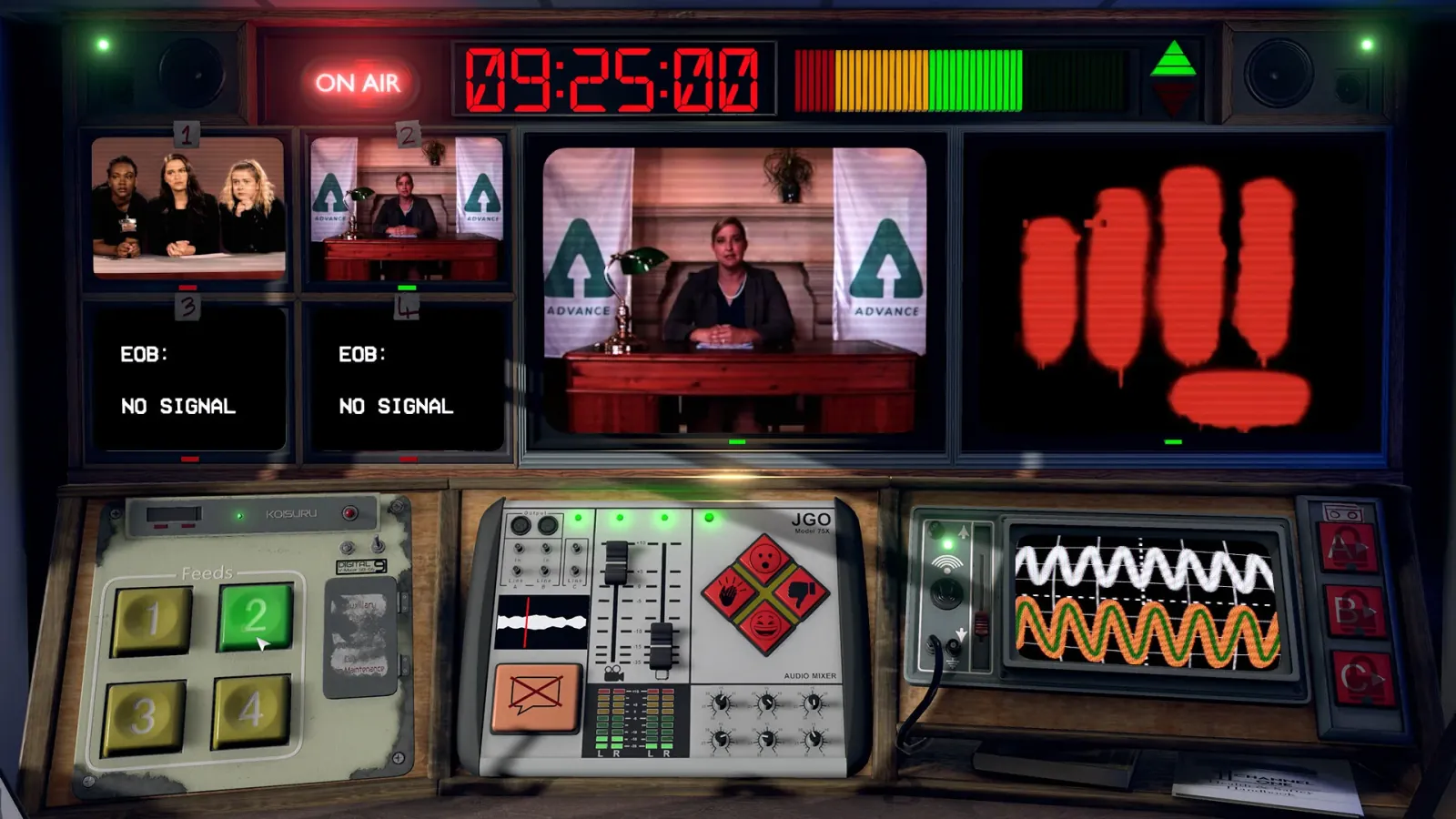
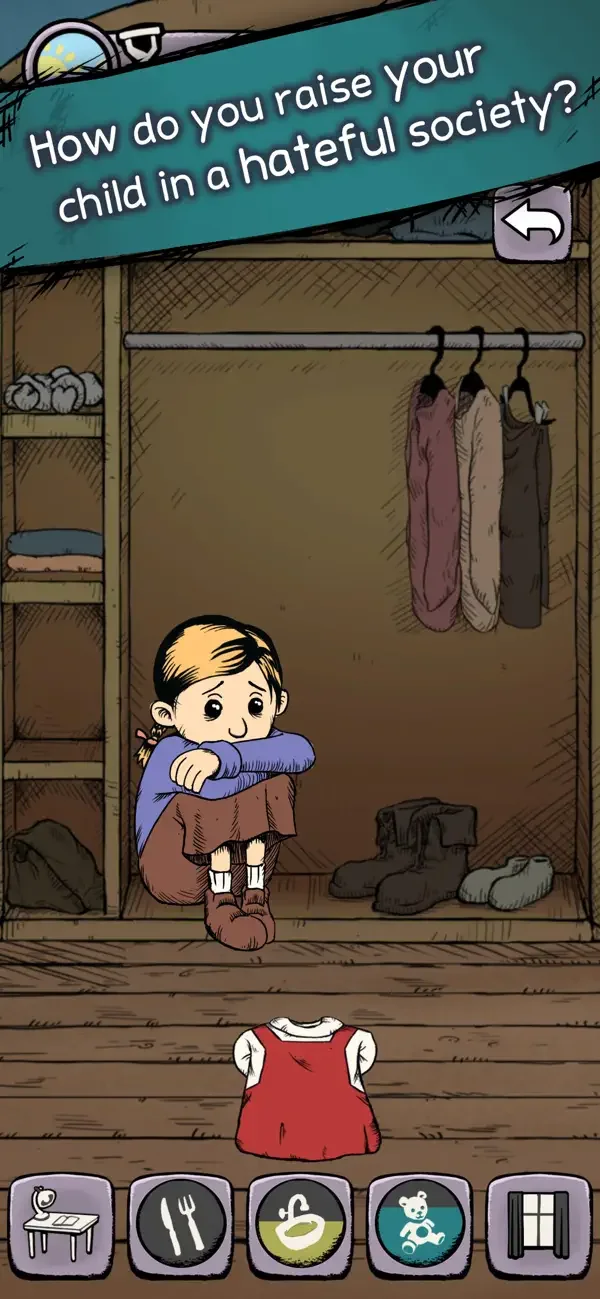
Players approve or reject news stories, then walk through a changing city where friends, strangers, and institutions react to the headlines they allowed through.
Why it may be useful
It may help you think about media framing and unintended consequences, because each short editorial choice produces a visible social ripple effect.
Keep in mind
The game reduces a news ecosystem to one all-powerful editor with no rivals or social media, so treat it as a prompt for reflection rather than a picture of how real journalism works.
Written 2026-09-15 · editorial assessment, not a measured effect · how we rate →
What the game is
Headliner: NoviNews puts you behind the desk of a state news outlet in an invented country. Each shift a stack of articles arrives and you stamp each one green to run it or red to spike it. The topics are the ones a country argues about: nationalized healthcare, a new synthetic alcoholic drink, rising tension with the neighboring state, who belongs and who does not.
Then you go home. The second half of a shift is a short walk through the city, past a bar, a pharmacy, a queue, your neighbors, and the city has changed to match what you published. Graffiti appears. A shop closes. A stranger recognizes you. Three characters in particular, including people close to you, have their lives bent by the headlines you let through. Unbound Creations released it in October 2018 for PC and later for Switch, at around fourteen euros, in English, French, Japanese, Korean and Simplified Chinese. Steam notes cartoon violence, including fighting and gunshot effects.
What you actually do
A run is short, an evening rather than a campaign, and it is built to be replayed. You read a headline and a paragraph of copy, decide whether the public sees it, and stamp. Nothing tells you what the right answer is, and there usually is not a clean one: a true story can inflame, and a spiked story protects someone while leaving everyone else uninformed. Consequences arrive on the walk home and in the next day's stack, so by the third shift you are partly choosing to repair what your earlier decisions broke. Endings come in combinations, so two players who both believed they were being responsible end up in different countries.
What it exercises
Reads a short news item and identifies what it is arguing for.
Predicts the likely effect of publishing or withholding a story.
Traces a change in the world back to an earlier decision.
Notices a personal bias by seeing which stories they keep approving.
Holds a position while the situation shifts underneath it.
Why we rate it Low Worksheet score 42 / 100
FitHow much real knowledge or skill does the play itself make you use?42weight 45%
Fit lands at 42. Approving or spiking a story is a single button press, and the city visibly changes because of it, so the link between framing and consequence is enacted rather than explained. It stops well short of a faithful model because the consequences are authored and tidy, which suggests real editorial effects are traceable when in practice they almost never are.
TransferWill what you practise here work outside the game?40weight 30%
Transfer sits at 40. Asking what a headline is doing and who benefits from it running is a real habit that carries directly into how you read the news outside the game. What holds the number down is that a real reader chooses what to believe, not what to publish, and the game hands over an editorial power nobody outside a newsroom actually has.
PracticeDoes the game make you use that skill again and again, as it gets harder?45weight 25%
Practice reaches 45. A run is short enough to replay in an evening, and different approval patterns do produce different cities and endings, so the same judgment gets exercised several times. But the article pool is finite and starts to repeat within a handful of runs, so the practice plateaus quickly rather than building toward anything harder.
What the evidence says
Editorial onlyNobody outside our desk has checked this. It is our reading of how the game plays.
The evidence level is Editorial only: a reading of the mechanics, checked against the Steam and Nintendo listings. There is no study of this game, and while media literacy is a well-researched field, we will not attach that literature to one small commercial title, so the transfer claim is reasoning rather than measurement. The reasoning is that the game makes a player commit to a position on a headline and then shows a consequence, over and over, which is a rare structure. The store pages support the October 2018 release, the developer, the price, the language list and the cartoon violence note.
Editorial assessment - not a measured scientific effect.
Fit
42/100
Transfer
40/100
Practice
45/100
Why it makes the cut
Its choose-the-headlines mechanic is clearly interactive and gamey enough to merit inclusion on its own terms.
Editorial only
Editorial: no study exists of Headliner: NoviNews, and while media literacy is a well-studied field, we will not attach that broader literature to one small commercial title, so the reasoning follows only from what the mechanic itself requires.
Prices are US store listings in USD, last refreshed 2026-09-25; regional prices and sales differ.
Single-player play is supported.
The core loop depends on reading short news items and noticing downstream social changes.
Nintendo currently verifies Japanese, French, Korean, Simplified Chinese, and English variants on Switch. Steam metadata also verifies French, Japanese, Korean, and Simplified Chinese, but German, Spanish, and Brazilian Portuguese were not directly verified.
Age guidance
Ages 12+ · PEGI 12
Topics
History & society
Play styles
Single-player, Narrative, Simulation
Tags
Media framing · Consequence tracing · Branching society sim
It rates low because approving or spiking a headline and watching a city react makes framing and consequence concrete, but the one-editor model is a tidy fiction, and a short run repeats the same judgment only so many times.