Players rotate, raise, lower, and reframe impossible structures so Ida can walk along paths that only make sense from the right perspective.
Why it may be useful
Rotating and reframing each impossible structure gives you brief, genuine practice in mental rotation and separating how something looks from how it is built, but the puzzles are short and the skill stays narrow, without much beyond the game's own invented geometry.
Keep in mind
It is a short, deliberately impossible world: about three hours of content that teaches nothing about how real buildings or space actually work.
Written 2026-09-15 · editorial assessment, not a measured effect · how we rate →
What the game is
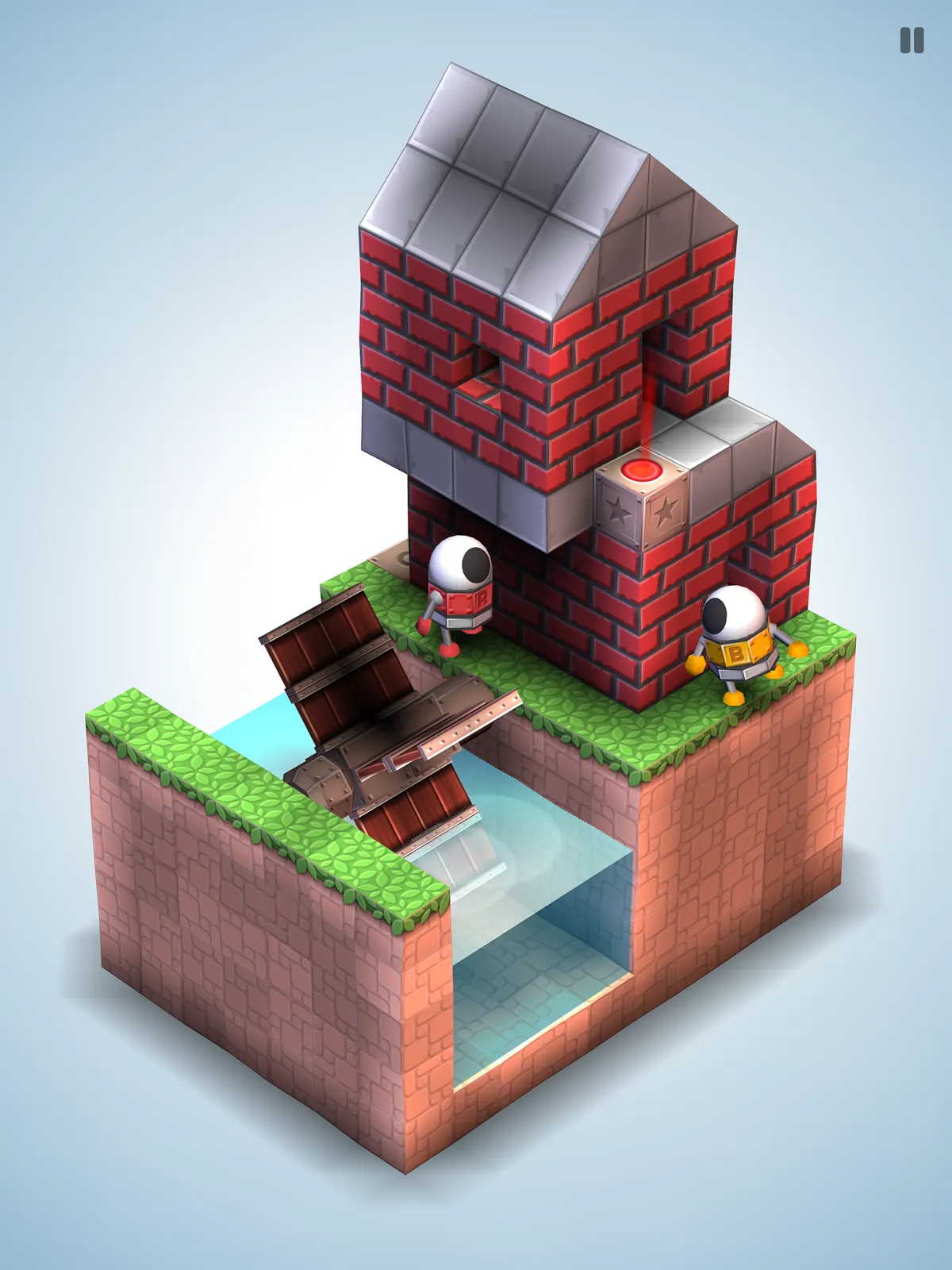
Monument Valley is a touchscreen puzzle game released in 2014 by the studio ustwo games. Each level is a small pastel building that could not exist: staircases that meet at the wrong angle, walkways that connect only when seen from one particular viewpoint, towers that fold in on themselves. A silent princess called Ida walks through them, and you make the impossible geometry line up so she can pass.
The whole game is quiet. There is almost no text, no timer, no failure state and no score. Crow people block some paths and shuffle along fixed lines, and a friendly totem block turns up to help, but nothing chases Ida and nothing can be lost. Chapters are short, five or ten minutes each, and the original runs to ten of them.
Access is worth being precise about. On phones and tablets you are buying the 2014 original, with an extra chapter set, Forgotten Shores, sold separately in the app. On PC through Steam you are buying the panoramic edition released in 2022, which is a reworked version of the same content for a wide screen. Monument Valley 2 and the collection are different products.
What you actually do
You tap where you want Ida to go and she walks there if a path exists. Since a path usually does not, the real work is in the handles: you drag a dial to rotate a tower, slide a bridge along a track, or twist the whole scene until two walkways that were on different levels appear to touch. In this world, if two edges look joined from your viewpoint, Ida can walk across them.
That is the trick the game teaches, and it teaches it by escalation. Early levels have one moving part. Later ones stack two or three, so rotating the piece that fixes one gap opens another, and you have to plan the order. Getting better looks like moving the camera and the mechanism before moving Ida, and learning to trust what a viewpoint shows rather than what you know the shape really is.
What it exercises
Rotates a structure mentally and predicts how the parts will line up
Separates how something looks from a viewpoint from how it is actually built
Plans a sequence of moves where each one changes what the next can do
Works patiently on a puzzle with no hint, timer or penalty for being wrong
Reads an unfamiliar interface with almost no written instructions
Why we rate it Minimal Worksheet score 22 / 100
FitHow much real knowledge or skill does the play itself make you use?25weight 45%
Fit is scored 25 because the perspective trick is the only mechanic, and every level is solved by changing the viewpoint or the geometry, so a player who finishes the game has spent the whole time doing exactly what we credit it with. It sits low because several levels can be brute-forced by dragging every handle in turn, and the reasoning demanded is real but genuinely light.
TransferWill what you practise here work outside the game?15weight 30%
Transfer is scored 15 because mental rotation and the idea that appearance depends on viewpoint are broadly useful ideas, but the game is short, its illusions are its own invention, and no study connects playing it to spatial performance anywhere else. What a player carries out is closer to a memorable aesthetic than a transferable skill.
PracticeDoes the game make you use that skill again and again, as it gets harder?25weight 25%
Practice is scored 25 because the same spatial reasoning recurs through every level, but the game is barely a handful of hours long: ten short chapters that most players finish in a few sittings, and once a level is solved it holds no surprise on a second run. Nothing brings a player back to the reasoning itself once the story ends.
What the evidence says
Editorial onlyNobody outside our desk has checked this. It is our reading of how the game plays.
The evidence level is Editorial only, and that is deliberate even though research using this exact game exists. A study in Frontiers in Psychology used Monument Valley to test how mental-health messaging changes which game people choose: 129 young adults aged 18 to 31 with at least mildly elevated symptoms were 3.71 times more likely to pick the version advertised as good for mental health, though the messaging did not change their experience of playing. A companion paper in Entertainment Computing examines motivation and mindsets in the same framing. Neither measured spatial reasoning, and neither involved children, so neither supports why the game is recommended here.
Editorial assessment - not a measured scientific effect.
Fit
25/100
Transfer
15/100
Practice
25/100
Why it makes the cut
Players would still seek out the impossible-architecture puzzles and calming visual transformations even if every useful-effect claim disappeared.
Editorial only
Editorial: the one study using this exact game tested mental-health framing in game selection, not spatial-reasoning transfer, so this assessment reads the puzzle mechanics rather than citing that research as support.
Prices are US store listings in USD, last refreshed 2026-09-25; regional prices and sales differ.
Offline single-player play is available.
Mobile versions include optional extra content purchases.
The current PC release is the panoramic adaptation released in 2022, not the original 2014 mobile build.
Do not treat Monument Valley 2 or the Monument Valley Collection as the same catalog entity.
Steam verifies French, German, and Spanish plus European Portuguese on the panoramic PC edition; the App Store lists English, French, German, Spanish, and generic Portuguese on the mobile original. Brazilian Portuguese was not explicitly verified for the current mobile listing.
Premium purchase on mobile and PC. Mobile also sells Forgotten Shores as an in-app purchase; the Steam panoramic version includes all Monument Valley content.
It lands in the lowest band because the perspective puzzles are elegant but short, a few hours of one invented visual trick, so what a player takes away barely extends past the illusions used here.