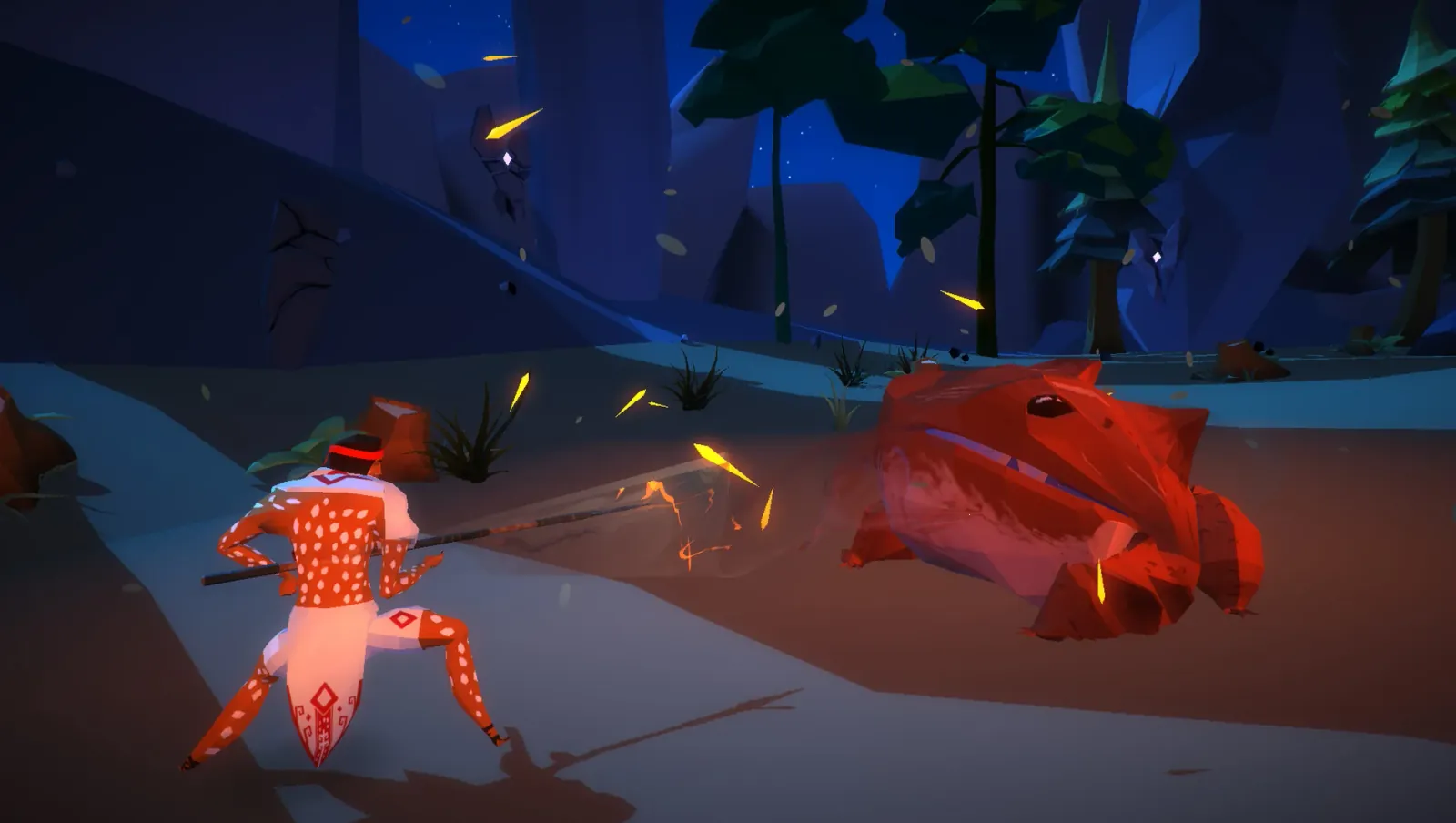
Players explore, platform, and fight through demon-filled spaces while absorbing narration and imagery connected to mythic inspiration.
Why it may be useful
This is an action game first: you fight and climb through a world built from Hindu and Balinese myth. The narration and art may spark curiosity about the sources, but that is a possibility, not knowledge you take away by playing.
Keep in mind
Treat the mythology as atmosphere and inspiration, not as an accurate account of Hindu tradition; the combat asks nothing of the story.
Written 2026-09-15 · editorial assessment, not a measured effect · how we rate →
What the game is
Raji: An Ancient Epic is an action adventure from Nodding Heads Games, an Indian studio, released in October 2020 for PC and consoles. You play Raji, a young street acrobat chosen by the gods after demons overrun the land and carry off her younger brother Golu. The camera sits above and behind her, and the game moves between combat arenas, climbing and platforming sections, and quiet puzzle rooms inside palaces and forts.
The look is the reason to notice it. Architecture is modeled on medieval Rajasthani buildings, and the flat painted panels that carry the backstory are drawn in the Pahari style, hand-painted and then rendered as three-dimensional models. The mythology draws on Hindu and Balinese sources, and the narration is spoken by the gods Durga and Vishnu, who comment on Raji's progress and tell the older stories behind what she is doing. It is single-player only, and Steam players rate it Very Positive across around two thousand English reviews.
What you actually do
Combat is the main verb. Raji fights demons with weapons granted by different gods, including a trident and a bow, and each has a different rhythm and range; you dodge, block and swap between them as a fight demands. Between fights you climb walls, swing on poles and run along surfaces to cross rooms that were built to be climbed. Puzzle sections ask you to rotate mechanisms, move blocks or find a route through a temple. Difficulty comes mainly from boss fights, which have patterns to learn. Getting better means recognizing which weapon a situation calls for before being hit.
What it exercises
Recognizes an enemy attack pattern and responds with the right tool.
Reads architecture for a climbable route through a room.
Follows a spoken narration that assumes unfamiliar names and stories.
Notices motifs in art and building style that repeat across the game.
Persists through a boss fight that requires several attempts.
Why we rate it Minimal Worksheet score 18 / 100
FitHow much real knowledge or skill does the play itself make you use?18weight 45%
Fit scores 18. The architecture you climb and the murals you pass are built from real sources, and that material is technically inside the game rather than tucked into a menu. But the actual play is combat and platforming, and neither asks you to engage with the culture at all; a player can clear every stage while treating the myth as scenery, which is why the number stays this low.
TransferWill what you practise here work outside the game?15weight 30%
Transfer scores 15. What is most likely to travel is a spark of curiosity: a name, an image, a sense that a larger body of stories exists somewhere behind this one. That is real, but it is not knowledge, and nothing in the game supplies the follow-up. A player who never looks anything up afterward keeps atmosphere and little else.
PracticeDoes the game make you use that skill again and again, as it gets harder?20weight 25%
Practice scores 20. Combat and climbing repeat constantly across the campaign, but that repetition has nothing to do with the cultural material, and each mural or narrated story appears exactly once. The skill genuinely rehearsed here is fighting demons, not sitting with myth, so the part that matters most for this rating barely repeats at all.
What the evidence says
Editorial onlyNobody outside our desk has checked this. It is our reading of how the game plays.
The record is Editorial only: our judgment from the mechanics and the visible content, with no research behind it. The sources are the Steam page, the PlayStation store page and the studio's own site, including a development article, which confirm the developer, the October 2020 release, the setting, the weapons, the narration by Durga and Vishnu, the Rajasthani and Pahari visual sources and the player reception figures used elsewhere on this page. No study has examined whether games like this affect cultural knowledge or curiosity. The claim here is deliberately weak: the game shows this material attractively and may prompt a question, nothing stronger.
Editorial assessment - not a measured scientific effect.
Fit
18/100
Transfer
15/100
Practice
20/100
Why it makes the cut
PASS - It is a real action-adventure game rather than a cultural exhibit.
Editorial only
This is our editorial reading of the mechanics and visible content, based on the Steam, PlayStation and studio pages. No study has looked at whether an action game like this affects cultural knowledge or curiosity.
Prices are US store listings in USD, last refreshed 2026-09-25; regional prices and sales differ.
Offline single-player play is supported on the verified routes.
Current PC availability is directly verified on Steam. Current PlayStation console availability is directly verified on PlayStation, and the official game site continues to present the same core product identity.
Steam currently verifies interface support for the listed locales. Full audio is captured only where Steam explicitly marks it; subtitle coverage remains unknown unless a platform source states it separately.
Age guidance
Ages 13+ · ESRB T
Topics
History & society
Play styles
Single-player, Narrative
Tags
Mythic interpretation · Action adventure · Cultural curiosity
The cultural material sits in the scenery you move through, but the actual verbs are fighting and climbing, and a player can finish the game while skipping every story the narration tells.