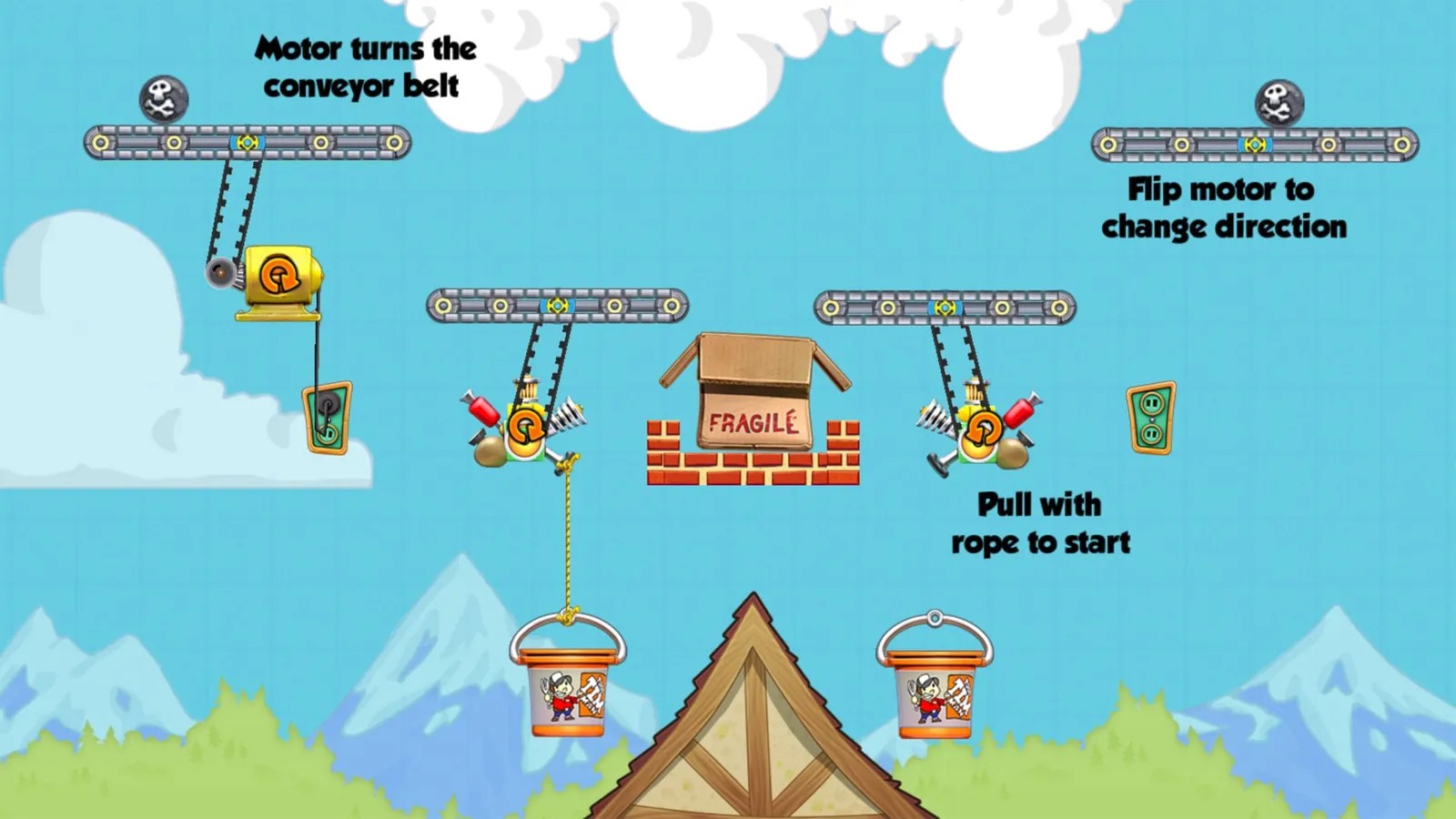
Players snap parts onto a grid — crates, wheels, motors, balloons, bellows, rockets — then let go and watch whether the contraption rolls, flies or falls apart on its way to the goal, tweaking and retrying.
Why it may be useful
Every failed build is a quick experiment: something tips, spins or falls apart, you change one part, and try again. The physics does the teaching without commentary, so a child forms real intuitions about balance and thrust, though some of them are exaggerated rather than accurate.
Keep in mind
The free version carries ads, in-app purchases and event pop-ups; the physics is cartoonish rather than accurate, and many parents will want to lock purchases before handing it over.
Written 2026-09-15 · editorial assessment, not a measured effect · how we rate →
What the game is
Bad Piggies is a physics construction game that Rovio released for phones in 2012, a spin-off of Angry Birds told from the pigs' side. Each level gives you a box of parts and a stretch of hilly ground with a goal at the far end. You build something out of the parts, press go, and watch what happens.
The parts are the whole appeal: wooden crates to make a frame, wheels, a motor, an umbrella, bellows, balloons, soda bottles and rockets. You snap them onto a grid, and the machine has real weight and balance. A cart with the motor at the back and the weight at the front will nose over. Balloons lift, rockets shove, and none of it is precise.
It is free on the App Store and Google Play with advertising, in-app purchases and event promotions in the menus. Levels have optional star objectives, and a sandbox mode lets a child build without a goal. Sessions are short by design and each attempt takes seconds, which is what makes the trial-and-error loop work.
What you actually do
You look at the terrain, guess what kind of machine will cross it, and build. Then you release it and it fails, usually amusingly: too heavy at the front, not enough thrust, a wheel that never touched the ground. So you change one thing and try again. Some levels are solved by a careful build, others by pressing the rocket at exactly the right moment. Star objectives ask for the same crossing done faster, or intact, or with a box collected on the way.
What it exercises
Predicts how weight and balance will affect a machine before releasing it
Changes one part at a time and observes what that change did
Works out which force is missing: lift, thrust, grip or braking
Redesigns a failed machine instead of repeating the same attempt
Times an action, such as firing a rocket, to a moment in a moving system
Why we rate it Low Worksheet score 46 / 100
FitHow much real knowledge or skill does the play itself make you use?45weight 45%
Build, test, observe, revise is the entire loop, and it runs in about fifteen seconds, which is a very good rate of experiment for a young child. The physics does the teaching without any commentary. The score settles at 45 because the game never asks a child to explain a result, only to fix it, and a purchased power-up can skip the design problem entirely.
TransferWill what you practise here work outside the game?40weight 30%
Intuitions about balance, thrust and center of mass do form here, and children who play it recognize the same problems in physical toys. But nothing is named or measured, the physics is cartoonish, and the fastest route to a star is often a trick rather than a better design, which holds this at 40.
PracticeDoes the game make you use that skill again and again, as it gets harder?55weight 25%
Hundreds of short levels plus a sandbox mean the build-and-test cycle runs many times in a single sitting, and star objectives give a reason to return to solved levels with a better design. It settles at 55 because power-ups let a player buy past the design problem, which cuts into how much is actually rehearsed.
What the evidence says
Editorial onlyNobody outside our desk has checked this. It is our reading of how the game plays.
The evidence level is Editorial only: our reading of the mechanics from Rovio's official page and the App Store listing, which confirm the studio, the free-with-advertising model, the in-app purchases and the current rating. No study of this game exists in our sources and none is claimed. Construction and tinkering have a research literature, but it concerns physical materials and classroom settings rather than this app, and using it here would overstate what we know. What is plain is the loop: build, release, watch it fail, change one part, release again.
Editorial assessment - not a measured scientific effect.
Fit
45/100
Transfer
40/100
Practice
55/100
Why it makes the cut
A Rovio comedy physics game with millions of players; the engineering thinking is a by-product of trying to keep the pig's cart in one piece.
Editorial only
Our reading of the mechanics from Rovio's official page and the App Store listing, which confirm the free-with-advertising model and current rating. No independent study of this game exists.
Prices are US store listings in USD, last refreshed 2026-09-25; regional prices and sales differ.
Age guidance
Ages 7+ · ESRB E
Topics
STEM, Creativity
Play styles
Single-player, Puzzle, Creative
Tags
Contraptions · Physics · Free with ads
Build, test, observe and revise is the entire loop, running in about fifteen seconds a cycle, but the game never asks you to explain a result, only to fix it, and power-ups let a player buy past the harder designs.