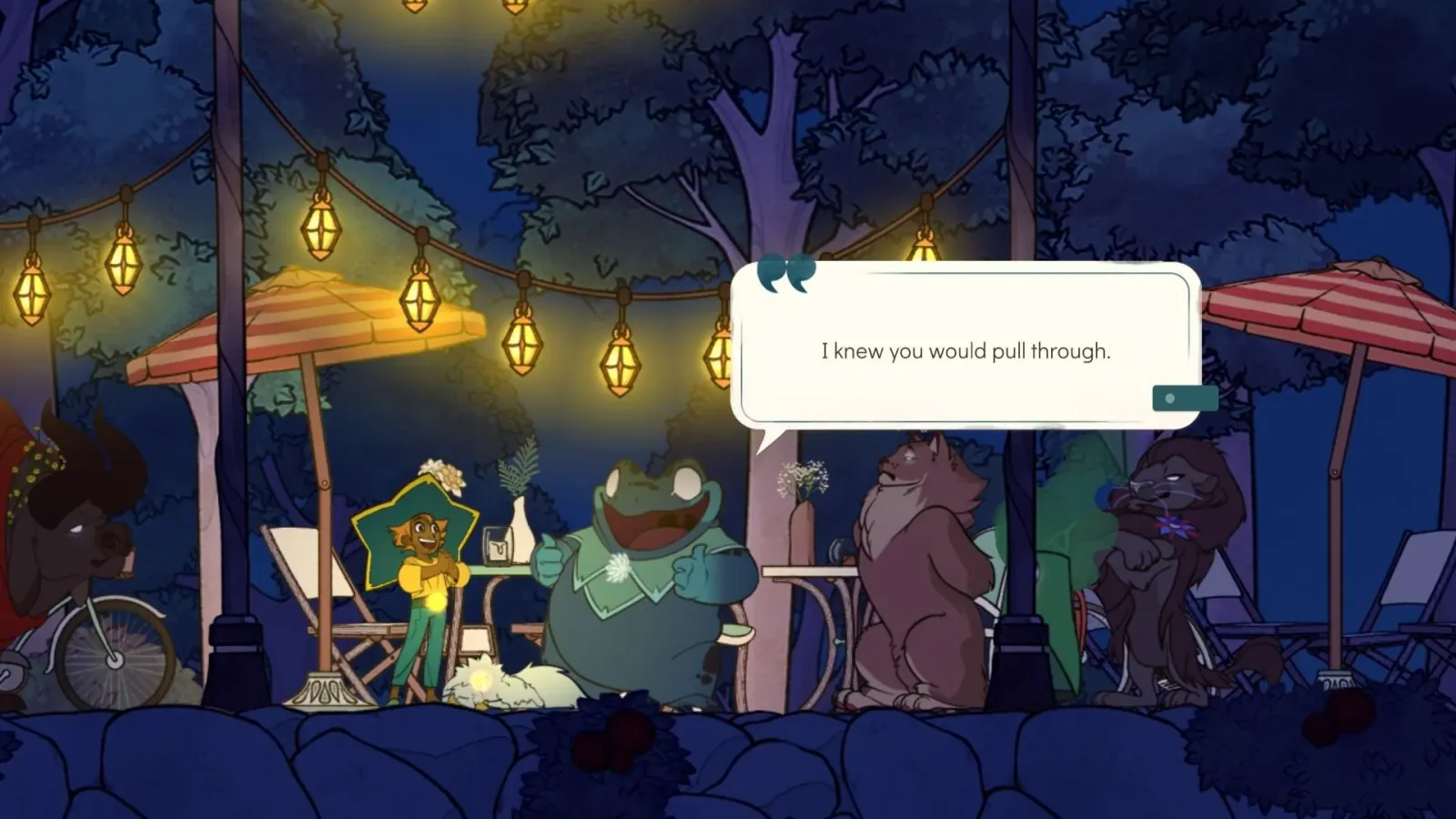
Players hike, climb, glide, fish, talk to other hikers, find hidden items, and choose their own route toward the summit.
Why it may be useful
You choose your own route up a mountain, help other hikers along the way, and set your own pace. The calm and kindness are tone rather than mechanics, so what you take from it is a pleasant mood, not a rehearsed skill.
Keep in mind
Most of its potential value is tonal and experiential rather than instructional; it does not model outdoor skills, ecology, or mental-health outcomes in any formal way.
Written 2026-09-15 · editorial assessment, not a measured effect · how we rate →
What the game is
A Short Hike is a small open-world exploration game made largely by one developer, Adam Robinson-Yu, released on PC in 2019 and later on Switch and Xbox. You play Claire, a bird visiting her aunt at Hawk Peak Provincial Park. She is waiting for a phone call, and the only place with reception is the summit.
The whole park is one hillside you can walk up in any direction. The look is deliberately low-resolution and chunky, closer to a nineties console than to realism, with a soft soundtrack and no combat of any kind. Golden feathers, found or bought or earned around the park, let Claire climb steeper rock and glide further, so exploring the lower slopes is what opens the upper ones.
It is short: a first climb takes an afternoon, and much of the park can be skipped entirely. Along the way there is fishing, a running race, a beach ball game, treasure to dig up and hikers who want to chat or need a favor. Nothing is timed and nothing can be failed.
What you actually do
You choose where to go. There is one goal, the summit, and no route to it. Most of the play is deciding whether to follow the path, cut across a ridge, or stop because someone on a bench looks like they want to talk. Helping people is optional and usually pays in feathers, which is the only progression: more feathers, more climbing, more of the mountain reachable. Getting better means reading the terrain, spotting where a glide will land, and budgeting stamina across a climb rather than sprinting up and falling.
What it exercises
Plans a route up terrain by reading slope, height and where a glide will land
Budgets a limited resource, climbing stamina, across a long ascent
Chooses a goal and an order to do things in without being told
Talks to characters and decides which small requests are worth taking on
Practices stopping and looking rather than rushing to the objective
Why we rate it Minimal Worksheet score 15 / 100
FitHow much real knowledge or skill does the play itself make you use?15weight 45%
This is the honest weak spot. The game is warm and beautifully paced, but almost nothing valuable is enforced by a mechanic: helping others is optional, the unhurried feel is tone rather than rule, and the only real system is a stamina meter for climbing. That is why the score is only 15.
TransferWill what you practise here work outside the game?12weight 30%
What the game models is worth modeling: unhurried attention, small helpfulness, choosing your own route. But it never asks you to practice any of it under pressure, and none of it is named or tested. At 12, whether anything carries out of the mountain depends far more on you than on the game.
PracticeDoes the game make you use that skill again and again, as it gets harder?20weight 25%
The weakest score here, and rightly so. One climb finishes the story, the park holds no randomness, and once the collectibles are found there is nothing new to reach. Some players replay it for the mood, but nothing in the design rehearses a skill across sessions, which is why practice sits at 20.
What the evidence says
Editorial onlyNobody outside our desk has checked this. It is our reading of how the game plays.
The evidence level is Editorial only. We checked the official site and the Steam, Nintendo and Xbox listings, which confirm the developer, the 2019 PC release, the 2020 Switch release, the platform spread and the ESRB Everyone rating. There is no research on this game and we cite none. This is a case where we have deliberately scored down. The game is widely loved, and it would be easy to attach claims about calm, attention or kindness to it. Nothing supports those claims, and the mechanics do not enforce them, which is why the mechanical case here stays limited.
Editorial assessment - not a measured scientific effect.
Fit
15/100
Transfer
12/100
Practice
20/100
Why it makes the cut
The mountain is fun to explore on its own, and the movement, secrets, and warm character encounters are the point.
Editorial only
Our reading of the mechanics, checked against the official site and the Steam, Nintendo and Xbox listings. No study of this game exists, and general nature-connection research does not concern this title.
Prices are US store listings in USD, last refreshed 2026-09-25; regional prices and sales differ.
Steam lists the original release on 2019-07-30 and Nintendo lists the Switch release on 2020-08-18.
Xbox currently shows an ESRB Everyone context; the proposed Meaningful Games age is slightly higher because it assumes independent reading and navigation rather than only content screening.
Steam reception was checked on 2026-08-20.
Age guidance
Ages 8+ · ESRB E
Topics
Mind & well-being
Play styles
Single-player, Narrative
Tags
Gentle exploration · Helping characters · Open wandering
Almost nothing the game values is enforced by a mechanic: helping others is optional, the calm pace is a tone rather than a rule, and the only real system is a stamina meter for climbing.