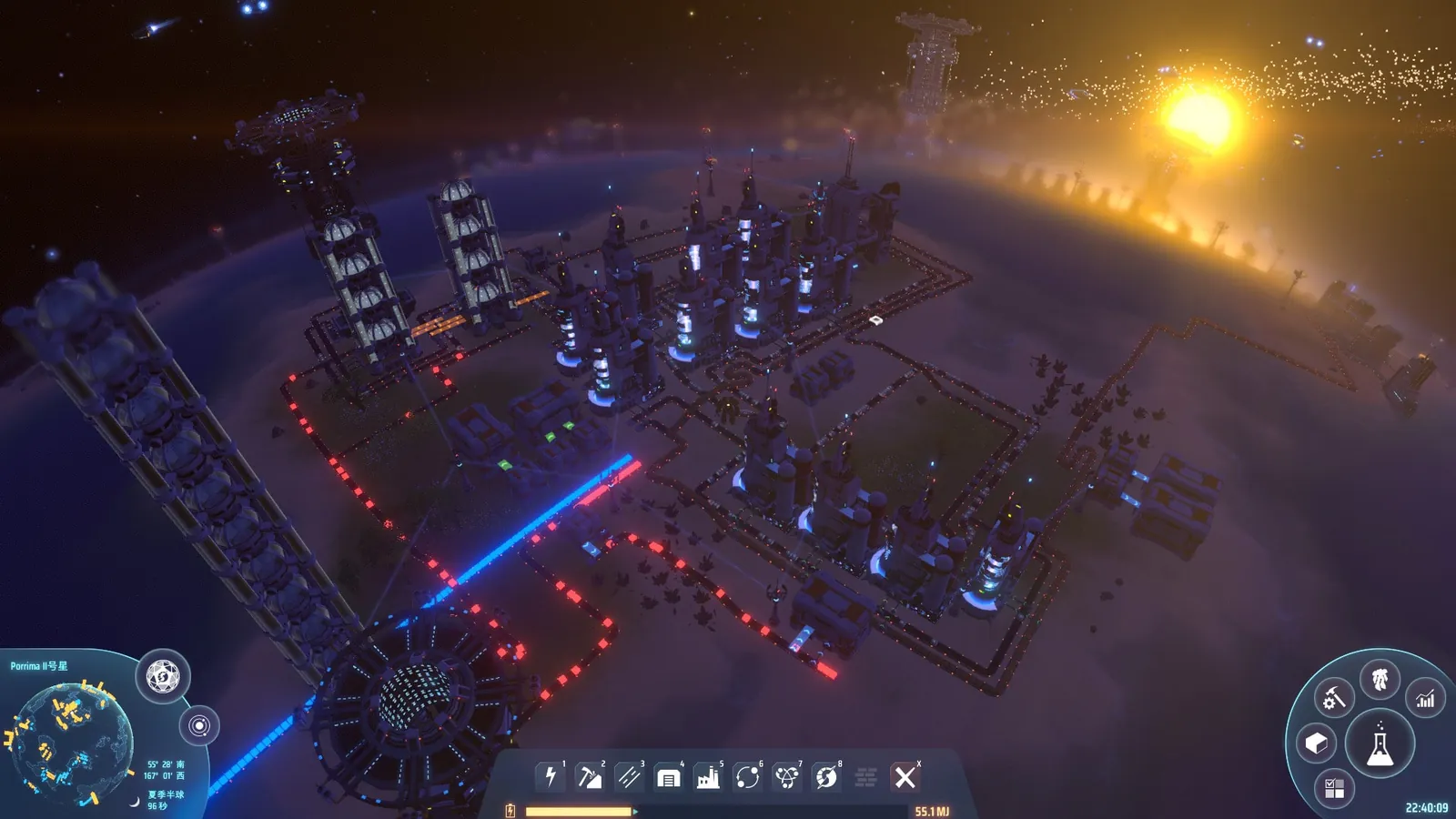
Players plan domes, power, water, oxygen, labor, and research while unexpected failures threaten the colony.
Why it may be useful
Every system is a dependency chain: power runs the water extractor, water runs the oxygen, oxygen keeps the dome alive. Tracing what depends on what before adding to it is a real engineering habit, though the numbers themselves are invented.
Keep in mind
This models stylized colony systems, not real Mars engineering, so do not treat any of it as scientific instruction.
Written 2026-09-15 · editorial assessment, not a measured effect · how we rate →
What the game is
Surviving Mars is a colony-building strategy game by the Bulgarian studio Haemimont Games with Abstraction, published by Paradox Interactive in March 2018. It is a paid PC game, single-player, with Steam Workshop support for mods.
You start by picking a sponsoring space agency, which fixes your funding, your research rate and what you can build, and then a landing site on a real map of Mars with different amounts of water, metals and rare minerals underneath. Nothing human arrives at first. You send drones and rovers ahead to build the power, water and oxygen infrastructure, and only once that works do the first colonists land.
People live inside domes, and each dome needs oxygen, water, power, food, housing and something to do. Colonists are individuals with traits and problems, so a dome of overworked scientists behaves differently from a balanced one. Each playthrough also seeds one of several mysteries, an unexplained event that unfolds over the game.
What you actually do
You lay cables and pipes, place solar panels or wind turbines, mine water from underground deposits, and watch the numbers. Everything is a chain: power runs the water extractor, water runs the oxygen, oxygen keeps the dome alive, and a dust storm that stops the panels stops all three unless you built storage.
The failures are instructive rather than sudden. A cable breaks, a battery drains overnight, a shortage develops three steps upstream of where the alarm appears. Getting better means building slack into the system before expanding, and tracing a problem back through the chain instead of patching the symptom.
What it exercises
Traces a failure backwards through a chain of dependent systems.
Builds spare capacity before adding demand to a network.
Reads a map for resources and plans a layout around what is underneath.
Balances several resources that each feed the others.
Weighs a research choice now against what it unlocks later.
Why we rate it Low Worksheet score 47 / 100
FitHow much real knowledge or skill does the play itself make you use?42weight 45%
Fit is scored 42. The systems thinking is not a theme laid over a builder; the dependencies are the difficulty, and a player cannot succeed by placing pretty buildings, only by understanding what feeds what. The game is unforgiving about slack not built in ahead of time. It stays in the forties because a fair share of play is exploration and research choices that do not themselves demand this reasoning.
TransferWill what you practise here work outside the game?35weight 30%
Transfer is scored 35. The habit of asking what depends on this before adding to it is a real engineering instinct, and it does move outside the game. The limit is that the numbers are invented, so a player gains intuition about dependency in general, not knowledge about power grids or life support specifically, and that gap is why the score sits closer to the middle.
PracticeDoes the game make you use that skill again and again, as it gets harder?70weight 25%
Practice is scored 70. A single colony returns a player to the same balancing act hundreds of times as it grows, and because each run has a different landing site, sponsor and mystery, restarting is normal rather than a punishment. That gives the loop plenty of repetition, though a colony that stabilizes stops demanding new reasoning from the player.
What the evidence says
Editorial onlyNobody outside our desk has checked this. It is our reading of how the game plays.
Editorial only. The Steam listing confirms the developers, the publisher, the March 2018 release, the single-player structure, the Workshop support and the nine listed languages, and it describes the sponsor choice, the drone-first construction, the dome life-support chains, the colonist traits and the per-playthrough mysteries. It supports nothing about learning. No study of this game exists. The systems-planning claim describes what the dependency chains force a player to do, and should be read as our editorial judgment rather than a demonstrated outcome.
Editorial assessment - not a measured scientific effect.
Fit
42/100
Transfer
35/100
Practice
70/100
Why it makes the cut
PASS - Its colony-management challenge is substantial enough to stand without any science-communication claim.
Editorial only
This is editorial: the Steam listing confirms the release, structure and described systems, but nothing measures what a player learns, so the systems-planning claim is our reading of what the dependency chains force a player to do.
Prices are US store listings in USD, last refreshed 2026-09-25; regional prices and sales differ.
No subscription requirement was found on the verified PC route.
Steam currently verifies interface support for the listed locales. Full audio is captured only where Steam explicitly marks it; subtitle coverage remains unknown unless a platform source states it separately.
Age guidance
Ages 10+ · ESRB E10+
Topics
STEM
Play styles
Single-player, Strategy, Simulation, Sandbox
Tags
Colony management · Infrastructure systems · Speculative survival
Every system here is a real dependency chain you must understand to succeed, but the numbers and the science behind them are entirely invented for play.