Players paint and recolor the world, solve environmental puzzles with the brush, explore side paths, and help characters by turning mark-making into moment-to-moment play.
Why it may be useful
Painting is the verb for both exploration and puzzles, so a color choice carries some weight rather than sitting on top as decoration. Puzzles mostly care that you painted in the right place, not what you painted, so the two halves run side by side rather than combining.
Keep in mind
Its creative value is real, but it is not a structured art-teaching tool, and some later emotional beats land older than the bright coloring-book presentation first suggests.
Written 2026-09-15 · editorial assessment, not a measured effect · how we rate →
What the game is
Chicory is an adventure game in which the world starts out black and white and you color it in. You play a dog who works as the janitor at the studio of the region's official artist. When she vanishes and all the color goes with her, you pick up her brush, which turns out to be more powerful than a brush should be.
Greg Lobanov led the small team that made it, Lena Raine wrote the music, and Finji published it in June 2021 for PC and Switch. It is drawn like a coloring book: thick black outlines on white paper, and every surface will take paint. The game runs about ten hours with its side quests, in eleven interface languages, and a second person can pick up a controller and paint alongside you. It is a paid game with nothing to buy inside it.
What you actually do
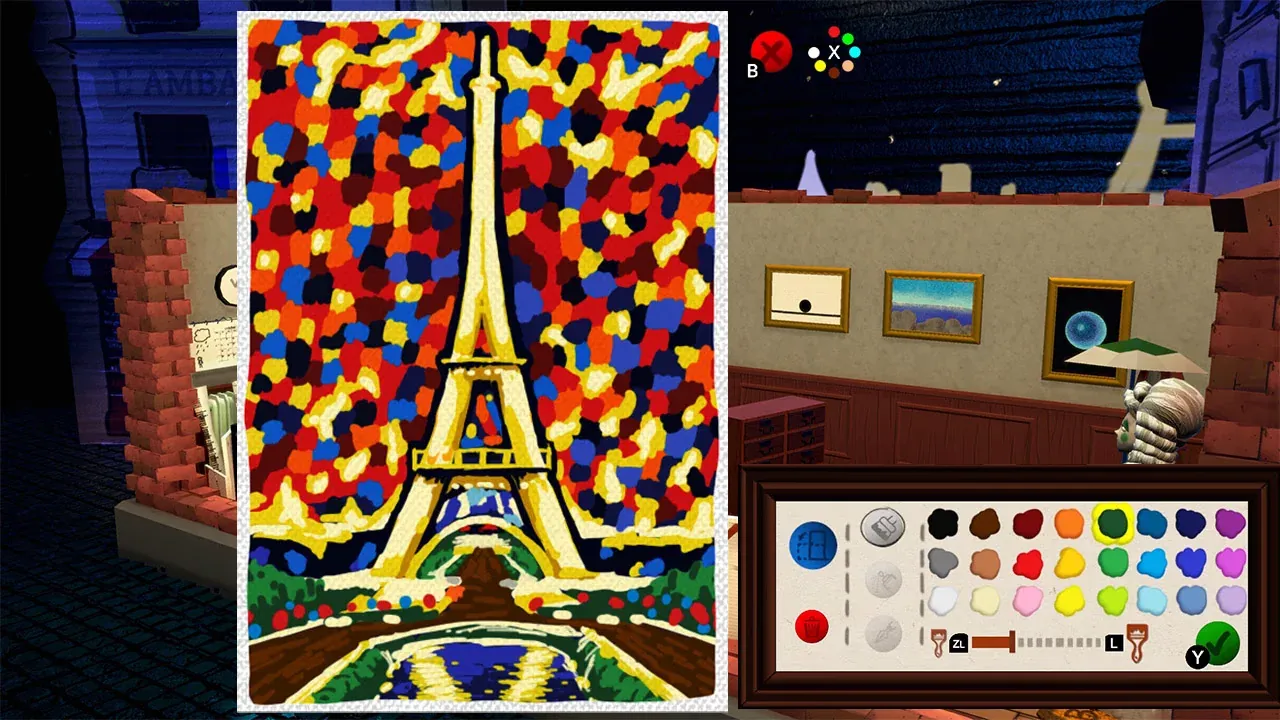
You walk around and you paint. The brush is on a stick or a mouse, and you choose a palette for each region, so one player's forest is orange and another's is sea green. Painting is also how you solve things: color a plant and it grows into a platform, darken a stretch of water and it holds your weight, mark a wall and something happens on the other side. New brush abilities arrive steadily and open up places you walked past hours earlier. Between puzzles the townspeople ask for things, such as delivering mail, taking a photograph, or painting a portrait to someone's taste, and the story turns on whether the brush is a gift or a weight.
What it exercises
Chooses a color scheme and lives with it across a whole region
Uses a drawing tool as a mechanism rather than as decoration
Remembers an earlier place that a new ability would now open
Paints to a stated request and adjusts when it is not what was wanted
Decides what a picture is supposed to do before making it
Why we rate it Minimal Worksheet score 29 / 100
FitHow much real knowledge or skill does the play itself make you use?30weight 45%
Fit sits at 30. Painting is the verb for both exploration and puzzles, so creative choices carry weight rather than sitting on top as decoration, which is a real strength. It falls well short of a strong score because the puzzles rarely care what you painted, only that you painted in the right place, so the expressive half and the problem-solving half run side by side rather than combining.
TransferWill what you practise here work outside the game?22weight 30%
Transfer is the weakest dimension, at 22. Making color choices with no right answer, and being asked to make something for a specific person, are close to how art actually works, and doing a hundred of these small commissions builds some comfort with starting a picture. But no technique is taught, there is no feedback on craft, and nothing here makes a school art lesson go any better.
PracticeDoes the game make you use that skill again and again, as it gets harder?35weight 25%
Practice reaches 35. Ten hours of continual painting is a fair amount of repetition, and the brush abilities keep changing what a stroke can do, so it avoids going stale for most of that time. What limits it is that once the story ends the world is painted and there is little reason to repaint it, and none of the practice is deliberate the way an exercise would be.
What the evidence says
Editorial onlyNobody outside our desk has checked this. It is our reading of how the game plays.
Editorial only: our judgment from the mechanics, checked against the Steam and Nintendo listings in August 2026. Those confirm the studio and the publisher, the June 2021 release, the PC and Switch routes, the eleven interface languages, local co-op, the composer, and the central idea that a player can paint on anything. No study looks at this game, and we found no research on drawing games and creative confidence that would apply to it. The claim here is modest: the game offers many low-stakes chances to make a visual choice and live with it, which follows from the way the brush is used.
Editorial assessment - not a measured scientific effect.
Fit
30/100
Transfer
22/100
Practice
35/100
Why it makes the cut
It is an excellent adventure game even before you consider any possible meaningfulness around creative confidence or expression.
Editorial only
Editorial only: no study looks at drawing games and creative confidence in a way that applies here, so the claim rests on how often the game gives you a low-stakes visual choice to make and live with.
Prices are US store listings in USD, last refreshed 2026-09-25; regional prices and sales differ.
Steam confirms the original release date of June 10, 2021 and currently shows Overwhelmingly Positive English reviews.
Nintendo's current eShop page confirms ongoing Switch availability and describes the game as a painting adventure where players can draw on anything.
Steam lists shared or split-screen co-op, but the core recommendation here is still framed around solo creative exploration rather than around co-op as the primary play mode.
This title does less direct gap-filling than the strongest Web or Technology & skills candidates, but it materially improves play-style variety and overall recommendation quality.
Age guidance
Ages 10+ · ESRB E10+
Topics
Creativity
Play styles
Narrative, Puzzle, Creative
Tags
Painting · Creative adventure · Helping others
Painting is the mechanism for both exploring and solving, so a color choice carries weight, but puzzles mostly reward painting in the right place rather than any particular choice you make.